New BELIMA archive protects Belarusian independent media from disappearing
 24 November 2026
On November 23, Kronika, a technology platform, launched the BELIMA (Belarusian Independent Media Archive) website. This initiative aims to preserve publications from Belarusian independent media outlets from the 1990s to the present day. Media archives are disappearing today due to blockings, newsroom closures, and emigration.
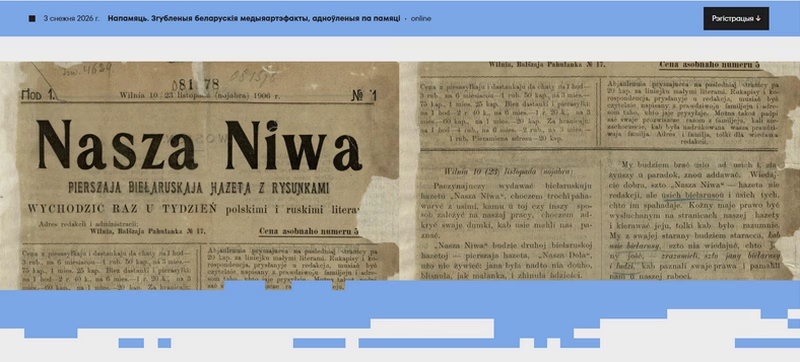
Screenshot of the BELIMA website
The project’s first partners are Nasha Niva, Euroradio, Buro Media, KYKY.org, and The Village Belarus. The website belima.media is available in Belarusian, Russian, and English. The full launch of the archive library is planned for 2027.
The Kronika platform was founded by Bard College in the U.S. and the human rights organization PEN America to protect journalism from digital oblivion.
“We want to identify what has disappeared, restore what can be recovered, and protect what is still at risk,” the archive’s creators stress. “In an age of digital oblivion, even journalism published online can vanish without a trace. Media outlets shut down, face cyberattacks, lose funding, stop maintaining their websites — and years of work disappear. BELIMA will preserve the voices and memories that must not be lost.”
Why it matters
“The past can be interpreted in different ways. But the situation today is clear: no independent media can operate openly inside Belarus. Independent journalism has not disappeared — but much of it has been forced into exile,” the creators remind readers.
According to the Belarusian Association of Journalists and the JX Fund, more than 60 Belarusian media organizations have been designated “extremist entities and organizations”; more than 400 journalists and media workers have been forced to leave Belarus; more than 100 news and media websites were blocked in Belarus in 2020–2021; more than 40 independent Belarusian media outlets continue to work in exile; and zero independent socio-political media outlets can work freely in Belarus and offer readers an alternative to the official position.
Preserving something doesn’t always mean making it public
“Safety comes first. We are working with the Belarusian media community to develop safety standards that will be continuously updated,” the archive’s creators say. “Some materials may need to remain out of public view for now. Our priority is to protect what is at risk and make it accessible when it is safe to do so.”
The archive is currently divided into several layers:
- Public: Digitized print publications and web materials freely accessible and searchable on the archive’s website.
- Research: Materials accessible to verified researchers, academics, and journalists.
- Closed: Materials securely preserved but not accessible to the public or external researchers.
- Open when safe: When it is safe to do so, BELIMA will grow into a living, continuously updated archive that makes journalism accessible and searchable.
Who it is for
Journalists and editors who want to preserve their work and prevent their professional record from becoming a “ghost portfolio” of dead links.
Researchers, historians, teachers, and students looking for primary sources on Belarusian history and society.
Investigative journalists and writers seeking to verify facts, trace events, and uncover overlooked stories.
Anyone writing about Belarus who wants to explore original reporting rather than rely on secondhand accounts.
Belarusians themselves — those who read, debated, and took part in shaping their country’s history, as well as those who are just beginning to discover it.
How to get involved
The BELIMA team is currently collecting archives and looking for editors, journalists, and readers who have kept print or digital copies of publications. Materials can be submitted or a secure backup can be made through the form on belima.media.


 @bajmedia
Open Letter from Former Belarusian Political Prisoners to European Leaders
26.10.2026
BAJ adopts Gender Policy
27.10.2026
Belarusian journalists in Białystok honor the memory of Uladzimir Pats
03.11.2026
Belarusian police question neighbors about exiled journalist Siarhei Skulavets’s visits home
20.10.2026